Pages

.

Thai Roast Duck Salad


So, I googled "game meat" and according to Wikipedia, "Game is any animal hunted for food or not normally domesticated. Game animals are also hunted for sport". I never knew that duck was considered game until someone told me that it is not commonly served or eaten in the United States for that very reason. Well, it makes sense now that I recall seeing duck hunting on TV (specifically the old Looney Tunes cartoons featuring Elmer Fudd and Daffy Duck - rings a bell?). Maybe because I've grown up eating a lot of Chinese roast duck (and Peking duck during special occasions), and so I can't say that it tastes gamey at all. Or maybe duck just tastes best when it's roasted until the fat has rendered and the skin's gone all thin and crispy. The only thing I don't like about duck is that it's really boney and fatty. If you buy half a roast duck, you'd end up with half of it being bones and fat. The meat and skin however is very tasty. If you've watched the "roast duck seller" chop up a roast duck before, you might notice how he tips out the juices from the cavity and reserves them, probably to make the duck sauce or gravy. It's so good over steamed white rice.


In my previous post, I wrote about my wine pairing lunch with a Thai-inspired theme, and one of the dishes was a Thai Roast Duck Salad. I bought the roast duck from the Chinese barbecue shop, which made the preparation of this salad really easy. Alternatively, you could buy some duck breast and pan-fry it until the fat's rendered and the skin's all thin and crispy. If after all my raving about duck and you're still not game (pardon the pun) enough for it, you can substitute the duck with beef steak, pan-seared to medium rare and thinly sliced. Or why not try it with stir-fried beef or chicken if you're in the mood for something warm? The proof is in the dressing!
 
Thai-style Roast Duck Salad
Serves 6
 
Ingredients
 
One whole Chinese roasted duck (store-bought), meat picked and sliced
200g (7oz) mixed salad leaves (spinach, endive/frisee, rocket)
1 handful fresh coriander (cut off the bottom part of the stem)
1 bunch fresh mint, leaves picked and roughly torn
1 cucumber, halved lengthways, seeded and diagonally sliced
1/2 red onion, thinly sliced
1 punnet cherry tomatoes, halved
Crispy fried shallots for garnish
 
Dressing:
6 cloves garlic, finely chopped
3 tbsp chopped scallions
3-4 bird's eye chillies, thinly sliced
7-8 tbsp freshly squeezed lime/lemon juice
3 tbsp fish sauce
3 tbsp grated palm sugar
3-4 tbsp Thai sweet chilli sauce
 
Method
 
  1. Using a mortar and pestle, pound the garlic into a paste. Then add the rest of the dressing ingredients and mix well using the pestle. Taste and adjust until you get the right balance of sweet, sour and salty. Set aside.
  2. Place the rest of the salad ingredients in a large bowl and top with the sliced duck meat. Just before serving, drizzle with the prepared dressing and toss well until evenly mixed. Garnish with crispy fried shallots.

reade more... Résuméabuiyad

Wining and Thai-ning

 Wine matching with Thai cuisine
 
 
Almost everyone we've ever invited over for lunch would have tried Mr G's Hainanese chicken rice, at least once. Mr G being Mr TFWL, but I'll save on the keystrokes. In fact, we serve it so often that people have come to expect it from Mr and Mrs G's House of Chicken Rice. Okay, so there are a couple of reasons why it has become a staple on our "menu". Firstly, everyone eats chicken (unless you're vegetarian of course, which means you'd best be eating rice with cucumbers) and I think the neutral flavours agree with the general palate. I can't think of anyone who doesn't like chicken rice. Secondly, it's pretty much a one dish meal served with rice, and perhaps accompanied by a side dish of stir-fried vegetables, which makes preparation a breeze. Coincidentally (ahem...), it also suits my personal agenda, as it means that Mr G does all the cooking while I sit back and relax. No, of course not. There are still appetizers and dessert to think about. But this post is not about chicken rice.

It's not easy to please everyone when it comes to food, and I usually try to avoid the common food aversions, like lamb for example. Lamb is like the national meat of Australia. I love lamb. In Malaysian cuisine, you'll find that mutton is often used instead of lamb. Mutton is also known as goat, or the meat that comes from older sheep. It has a stronger taste and smell compared to lamb that people may find offensive, and the meat tends to be very tough. Because of this, I prefer my mutton to be slow-cooked in rich spices to cloak the strong gamey taste, and if done well, it can taste quite exotic and delicious. Mutton curry and mutton soup (Malaysian "Sup Kambing") are some of my favourites. On the other hand, lamb is quite different and does not have the overpowering taste of mutton. I digress.

I suggested to Mr G that he got some of his friends together for a wine pairing lunch with a Thai-inspired menu. As I had never met them before, there were no expectations about their food preferences. Therefore, I had no qualms about putting lamb on the menu, although I prepared a contingency dish of Thai barbecue chicken ("Gai Yang") just in case. We seldom have wine with Asian dishes as the highlight of the meal is always the food, not the wine. It can be tricky when choosing the right wine to match especially when the dishes are spicy, which tend to kill the flavours of the wine you're drinking. Wines that are high in alcohol, tannin and oak are best avoided when eating spicy food. A glass (or two) of ice-cold water is probably the first thing I would reach out for.


Anyway, I spent some time planning out the menu and developing the recipes. With some help from the staff at the liquor store, I think we made some good selections with the wine matching, and all within budget. Here's a snapshot of what we served:

The Menu

Oysters with lemongrass, ginger, chilli and lime
Torresella Prosecco - Extra Dry

Thai-style Roast Duck Salad
Emperor's Prize Pinot Noir 2010

Spicy fish mousse
Tolley Musica Pinot Gris 2012

Massaman lamb shanks
2009 d'Arenberg The Custodian Grenache

Oysters with lemongrass, ginger, chilli and lime
Torresella Prosecco - Extra Dry
For starters, we served fresh Sydney rock oysters with a Thai-style dressing made with lime juice, palm sugar, chilli, fish sauce, ginger, lemongrass and scallions. I held back on the chilli as I didn't want it to overpower the Prosecco, an Italian sparkling wine made from Prosecco grapes. As oysters are naturally salty, a high acid wine (also Champagne, Riesling or Semillon) helps to temper the saltiness as well as stimulate the salivary glands. That probably explains why sparkling wine is usually served at the start of the meal to whet the appetite.
 
Spicy fish mousse
Tolley Musica Pinot Gris 2012
The fish mousse (or as we call it in Malaysia, "Otak-otak") was actually quite spicy. It's made with fish, red curry paste, coconut cream and eggs, and then steamed over banana leaves. I was afraid that the chilli might clash with the Pinot Gris, which was a light and crisp white wine with a musky pear aroma. Surprisingly, both paired really well, as the Pinot Gris has no oak nor tannins and delivered a nice smooth finish that complemented the silky texture of the fish mousse.

Thai-style Roast Duck Salad
Emperor's Prize Pinot Noir 2010
Next, we opened the bottle of Yarra Valley Pinot Noir, described as being full-flavoured with ripe plum, cherry and spice characters. Some of us begged to differ and found the wine to be relatively light and medium-bodied, with a light berry colour that was reminiscent of Ribena (as in the blackcurrant drink). Nevertheless, we gave it a unanimous thumbs-up that it was a perfect match with the Thai-style duck salad. Remember, if you're having duck, you can't go wrong with a Pinot Noir!

Massaman lamb shanks
2009 d'Arenberg The Custodian Grenache
As we got to our fourth and final bottle of wine, some of us started feeling a little too happy and the volume level at the dining table started to elevate by fractions of a decibel with each sip of wine. But really, four bottles of wine (which we didn't finish) were quite reasonable considering there were seven of us, enjoying a slow and long lunch with good company, good food (ahem...) and a wonderful selection of wines.

We had the lamb shanks with our final bottle, a Grenache, which was more full-bodied and earthy with a long finish. It was an excellent pairing with the Massaman lamb, which was mildly flavoured and with hints of sweetness from the palm sugar. I think the fact that the lamb was quite subtle in taste (after hours of slow-cooking which probably infused it with all the spices) made it "palatable" even to those who didn't usually eat lamb. For the recipe, please click here.

Honeydew and sago pearls in coconut milk

We ended our meal on a sweet note with honeydew sago, made with honeydew, sago, coconut milk and sugar syrup. After a busy morning in the kitchen, I figured this would be an easy one to prepare. The sweet and ripe cubes of honeydew immersed in cold sweet coconut milk, interspersed with little sago pearls, made for a delightful bowl of dessert which was light and refreshing. At the thought of coconut, Malibu rum sprang to mind and I brought out the bottle should anyone decide to continue with the booze fest we were indulging in that afternoon. It's no surprise that a splash of Malibu worked really well with this dessert, much like an essence of coconut with an alcohol hit. Adults only, please. And in case you were wondering, no kids were intoxicated in the making of this lunch.


reade more... Résuméabuiyad

Strawberry Vanilla Cream Cake


The thing about kids' birthday cakes is that, it's not what's on the inside that counts, but what's on the outside. Always judge a cake by its icing. Well, the icing is always the first thing to go whenever I present cupcakes to my kids anyway, whilst the cake is left behind, still stuck to its cupcake liner. Remember that episode from Seinfeld where Elaine had that idea about selling muffin tops? Now, wouldn't that be a fabulous idea for cupcakes too? *wink*

When it came to deciding what cake to make for Z's birthday, it was simply a choice between vanilla or chocolate, and Z chose vanilla. Vanilla and strawberries. I wished he could have chosen something a little bit fancy so that I had an excuse to bake something different. I did a search on strawberry vanilla cakes and found this recipe which had pretty rave reviews. I usually don't believe in butterless cakes, although this one which uses vegetable oil with a hint of lemon zest tastes pretty amazing. The fact that it uses oil instead of butter probably explains why the cake is so cottony soft, light and melts in your mouth. Each layer is laced with strawberry, lemon and vanilla syrup, and combine that with the vanilla cream and fresh strawberries and there's your slice of heaven. Cheesy as that might sound, but it's truly one of the yummiest strawberry cream sponge cakes I've had in a long time. Go for it!

Note: The recipe below makes 4 layers of cake. I actually used only 3 layers (as you can see from the photos) so that the cake wouldn't be so tall. You could just do 2 large layers if you like.  Am I making sense? :)

 
Strawberry Vanilla Cream Cake
Adapted from GroupRecipes

Ingredients:

For the berries:
2 punnets strawberries, rinsed, hulled and horizontally sliced into 1cm thickness
2 tablespoons granulated/caster sugar
2 tablespoons freshly squeezed lemon juice (from about 1/2 lemon)
1 1/2 teaspoons vanilla extract

For the cake:
2 cups cake flour
2 teaspoons baking powder
1/4 teaspoon fine salt
1/2 cup vegetable oil
1/4 cup water
1 teaspoon finely grated lemon zest
2 teaspoons vanilla extract
6 large eggs, separated
1 1/2 cups granulated/caster sugar

For the filling:
1/2 cup thick vanilla custard (made using 2 tbsp instant custard powder mixed with 1/2 cup water)
1 1/2 cups heavy cream
3 tbsp icing sugar
1 1/2 tsp vanilla extract

For the frosting:
1 tsp vanilla extract
2 tablespoons icing sugar
1 1/2 cups heavy cream
1 tsp gelatin powder dissolved in 1 1/2 tbsp water

Extra strawberries for decorating

Method
 
For the berries:
  1. Combine all ingredients in a medium nonreactive mixing bowl and toss to thoroughly coat strawberries. Let macerate at room temperature at least 20 minutes before using.
  2. Strain macerated berries and reserve syrup separately.
For the cake:
  1. Heat oven to 180°C (350°F) and arrange rack in the middle. Grease and flour two (8-inch) cake pans. Sift flour, baking powder, and salt together into a mixing bowl; set aside.
  2. In the bowl of a stand mixer fitted with the whisk attachment, combine vegetable oil, water, lemon zest, vanilla extract, egg yolks, and 1 1/4 cups of the sugar. Whisk on medium-high speed, until mixture is airy and light in color, about 5 to 7 minutes. Turn off the mixer and scrape down the sides of the bowl; add dry ingredients and whisk until smooth, about 1 minute more. Don't worry if the batter turns out really thick. That's how it is!
  3. In a clean bowl, whisk egg whites to medium peaks. Add remaining 1/4 cup sugar and continue whisking until stiff peaks form, about 1 minute more. Using a rubber spatula, fold 1/4 of the egg whites into the cake batter until evenly incorporated; gently fold in remaining egg whites until just combined.
  4. Divide batter between prepared cake pans. Bake until surface of cakes springs back when pressed and a toothpick or cake tester inserted into the center comes out clean, about 25-30 minutes. Remove cakes from the oven, and turn them out onto wire racks to cool completely. Meanwhile, make the filling and the frosting.
For the filling:
  1. Combine cream, sugar and vanilla in a bowl and use a whisk to whip until soft peaks. Add prepared custard and whip again until just combined. Cover and refrigerate until ready to use.
For the frosting:
  1. Combine vanilla extract, sugar, and heavy cream in a bowl and whip at medium speed until soft peaks form. Whisk in the gelatin solution until firm peaks form.
  2. Cover and refrigerate until well chilled, at least one hour.
To assemble:
  1. Using a long serrated knife, trim the tops of the cakes as necessary so they are level. Slice each cake horizontally in half to make a 4-layer cake.  Place cake rounds on a clean, dry surface and, using a pastry brush, brush 1/4 of the reserved strawberry syrup on the cut side of the first cake round; repeat on the cut side of the second cake round and the repeat with the rest.
  2. Evenly spread some of the cream filling over the cut side of the bottom cake layer. Arrange strawberries over the cream and cover berries with the remaining filling, being sure to fill in any empty space.
  3. Place second cake layer over cream and strawberries, pressing gently to secure it. Repeat the layering with the remaining cream and strawberries so that you have 4 layers of cake and 3 layers of strawberries and cream filling in between.
  4. Using an offset spatula or a long, thin spatula, spread the frosting in a thin layer over the top and sides of the cake. Return remaining frosting and cake to the refrigerator until frosting on cake is set, about 15 minutes.
  5. Spread the remaining frosting all over the top and sides of the cake. Let sit in the refrigerator at least 15 minutes before serving. Decorate the top with extra strawberries if desired.


reade more... Résuméabuiyad

Baked Kale Chips


There's been all this hype over kale chips, and how they taste like potato chips, except that they are loaded with vitamins and minerals. I finally bought some kale from the supermarket last Sunday and was pretty excited to make these. It's really easy. Roughly tear up the kale into pieces, and then wash and dry them thoroughly. Lay them out on a baking tray lined with baking paper, drizzle with a little olive oil and sprinkle with a pinch salt. Be careful not to put too much oil or salt, because the kale will shrink to a quarter of its size and you don't want to end up with oily salty kale chips (now how did I know that?). Bake them in the oven at 180C (350F) for 20 minutes, turning once halfway through. They will be turn translucent and crispy, and they really taste almost like potato chips! And totally guilt-free!

PS: These make a good substitute for crispy seaweed, the Japanese or Korean type that comes in individual packs and taste so umami with flakes of MSG all over. I reckon these kale chips would be great as a topping for noodle soups, or even crumbled over some pasta.
reade more... Résuméabuiyad

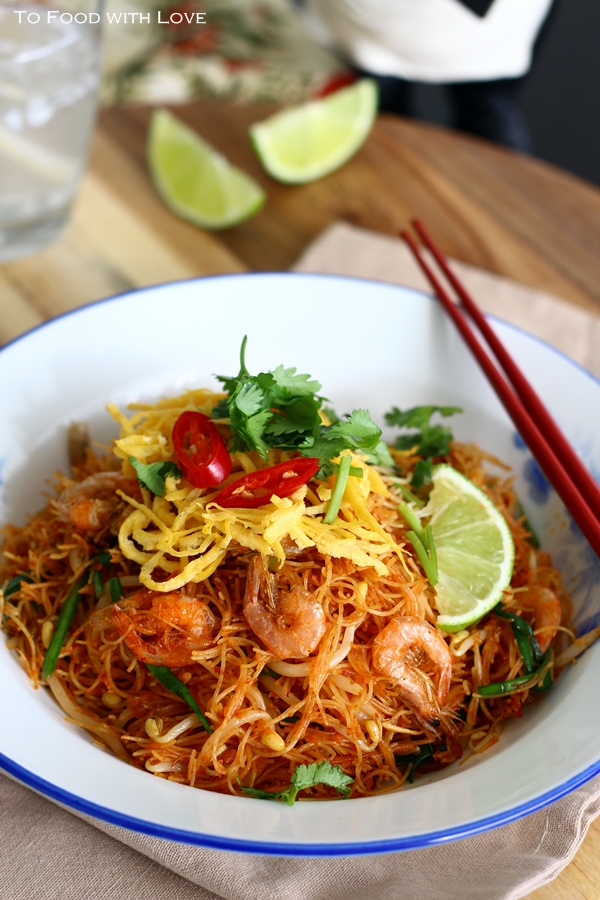
Fried Mee Siam (Vermicelli) with Crispy Shrimp


It was a bright and sunny Sunday morning. I was riding in the car when this song started playing on the radio:
 
Whatever I said, whatever I did I didn't mean it,
I just want you back for good,
(Want you back, want you back, want you back for good...)
 
Does that sound familiar? Well, Take That! Listening to the song evoked memories from my 21st birthday which I celebrated with my college friends. I still have photos from that day, when I had my first go at ice-skating and ended up with cuts and grazes from constantly breaking my fall with my bare hands. A couple of my friends had brought a guitar along and made a notable attempt to serenade me with "Back For Good", which is why hearing the song again made me feel quite nostalgic.


Like music, food can sometimes trigger feelings of nostalgia too. Back in my childhood days, before my cousins and I grew up and went our separate ways, we used to come together during festivities and celebrations, like Chinese New Year, birthday parties or just family get-togethers. The "women" in my family are great cooks, and they each have their "specialty" dishes. One of my aunts makes the most delicious fried mee siam (Malaysian-style spicy fried vermicelli) and I would always look forward to it during these family events. Now, whenever I see this dish, I would look back and reminisce about the wonderful times we had back then, eating together and enjoying good food.
 
 
How could I possibly not learn how to cook mee siam, one of my all-time favourite Malaysian dishes (amongst many others)? In fact, it was one of the first few dishes I learnt to cook when I moved into my own apartment and had full unlimited no-holds-barred access to the kitchen. Ah.... Now, that reminds me of the time I was renting a room and my vegetarian landlady kicked up a big fuss when the braised pork belly dish I was cooking simply engulfed her entire apartment in a whirlwind of porky and garlicky smells. Her instant reaction was to run to the balcony where she almost screamed her head off. It was quite a funny sight though, and rather unexpected. That was probably the last time I cooked in her kitchen.
 
Anyway, this Fried Mee Siam has been my go-to dish whenever I have guests over for lunch, or as my contribution to potluck lunches or dinners. It's simple, yet so tasty especially with the refreshing tang and acidity from the lime/lemon. The crispy shrimps (or school prawns) are lovely too, though you may omit them if you wish to keep it simple. I like to use Wai Wai brand of vermicelli noodles for this, as their superfine and silky texture allows the flavours to be better absorbed. It's quite a popular brand, and should be available at most supermarkets. Please find the recipe after the jump.


Fried Mee Siam (Vermicelli) with Crispy Shrimp
 
Ingredients
 
200g school prawns (tiny shrimp) with head and tail on, washed and feelers trimmed
Vegetable oil
2 cups chicken/beef stock
1/2 tbsp chicken stock powder
2 tbsp fish sauce
3-4 tbsp sugar
1-2 tbsp dried tamarind pulp, mixed with 1/4 cup hot water  until softened, then strain the pulp
1/4 tsp pepper
500g Wai Wai brand vermicelli noodles, soaked in water for 5 minutes until softened
 
Blend finely:
5 cloves garlic
3 large onions
20 dried chillies, deseeded and soaked in warm water
1/2 cup dried prawns
 
1 packet bean sprouts (about 200g / 7oz)
1 bunch garlic chives (about 150g / 5oz), cut into 2 inch lengths
 
Garnish:
4 eggs, beaten, seasoned with salt and pepper, fried into a thin omelette and finely shredded
2-3 limes or lemon wedges
Crispy fried shallots
Coriander leaves
Crispy fried shrimp
 
Method
 
1. Pat dry the shrimp with a paper towel. Sprinkle with a little salt. Heat up 1/2 cup vegetable oil in a wok and slowly deep-fry the shrimp for 5 minutes until crispy. Remove and drain on kitchen paper. Leave the oil in the wok.
 
2. Heat up the same oil in the wok. Fry the blended ingredients for 4-5 minutes. Add stock, chicken stock powder, fish sauce, sugar, pepper and tamarind liquid. Bring to a boil and simmer for 5 minutes.
 
3. Add the vermicelli and mix until well combined. Toss for 2-3 minutes until the liquid has been absorbed and noodles are almost dry. Add bean sprouts and chives and mix them into the noodles. Transfer to a serving plate and top with garnish. Squeeze over some lime/lemon juice before serving.


reade more... Résuméabuiyad

Salmon with Black Bean Sauce


Have you ever tried salmon with black bean sauce before? Honestly, I never knew salmon could be prepared this way until I found out from some friends that it is a common Chinese dish. I uusally cook salmon with either miso or teriyaki sauce, but with black beans? It actually turned out really good - sweet, salty, smoky (from the beans), with a hit of chilli in there. These flavours are just perfect with a bowl of steamed white rice, and it's all you really need for a satisfying meal. Of course, to make it complete, serve it with a plate of stir-fried asian greens like bok choy or snow pea sprouts.

I used fermented black beans that came in a jar, and not the dried ones that come in a packet. You should be able to find them at the Asian supermarket at the aisle where all the sauces and jars of pastes are. I've never tried the dried version before, so I'm not sure if they are any different. The flavours should be similar though. If salmon with black bean sauce is new to you too, why not try making this at home? It's pretty quick and easy, and most importantly, it's delicious served with white rice. I pan-fried the salmon, but you could easily steam of bake it in the oven for a healthier alternative.

 
Salmon with Black Bean Sauce

Ingredients

2x salmon fillets - about 450g / 1 lb
Salt
Vegetable oil

Sauce:
3 cloves garlic, chopped
1 inch ginger, grated
2 tbsp fermented black beans, chopped
1-2 bird's eye chillies, chopped (optional)
1 tbsp chinese cooking wine
2-3 tsp sugar
Dash of pepper
1 tsp soy sauce
1/2 tsp Cheong Chan brand thick caramel
1/4 tsp sesame oil
1/4 cup water

Cornflour solution:
1 tsp cornflour mixed with 1 tbsp water

Garnish:
Chopped spring onions
Sliced red chillies

Method

  1. Prepare the sauce first. Heat up a small frying pan with 1/2 tbsp vegetable oil. Add garlic, ginger, black beans and chillies. Fry for 1-2 minutes until fragrant.
  2. Add the rest of the sauce ingredients and bring to a boil. Simmer for 1-2 minutes, then add cornflour solution to thicken the sauce. Stir until it comes back to the boil. Turn off heat and keep warm.
  3. Clean the salmon fillets and pat dry with paper towel. Rub a little salt over the fillets. Heat up vegetable oil in a clean non-stick pan and fry for about 3 minutes each side or until just cooked. Transfer onto a serving plate and pour the black bean sauce over it. Garnish with chopped spring onions and chillies if desired. Serve hot with steamed jasmine rice.
Note: For the salmon fillets, you can choose to steam or bake them instead. Place the fish in aluminium foil and top with the cooked black bean sauce. Wrap in the foil, then bake in preheated oven at 200C/400F for 12-15 minutes until just cooked.
 
reade more... Résuméabuiyad

Exploring China – A Culinary Adventure (DVD REVIEW and GIVEAWAY - CLOSED)

I'm thrilled to be writing a post (sponsored by Nuffnang) reviewing the newly released DVD, SBS Cooking Titles - "Exploring China - A Culinary Adventure", featuring Ken Hom and Ching-He Huang. SBS is my go-to for all foodie programs, with my favourite being Food Safari. Showcasing the best in local & international cuisines, SBS is home to a who's who of the food scene – along with Luke Nguyen, Peter Kuruvita, Maeve O'Meara, Tetsuya, Matthew Evans, Adriano Zumbo and many more.  Ken Hom is just one of the SBS chefs and personalities whose wonderful shows are available on DVD. Click here to watch the trailer
 

"Exploring China" is a new series which was aired on SBS early this year, and comprises four episodes where Ken and Ching cook their way across China in a visually rich culinary journey. If you missed the premiere of this new series, don't worry because you can now get them on DVD - all four episodes in one! Read on to find out how to win one of these!
 
Ken Hom is regarded as the godfather of Chinese cuisine and is also one of the world's leading authorities on Chinese cookery. He is also known as the man who "introduced the wok to the West". A visit to his website will show that he's a prolific producer of cook books and with a slew of TV series, there is no doubt that he makes the perfect gastronomic guide.
 
Ching is a self-taught cook of Taiwanese descent and is based in the UK. She cooks with a conscience with an ethos for sustainability, and has already starred in three popular TV series. She is also the author of five best-selling cookbooks.

In each of the four episodes (running time of 59 minutes each), Ken and Ching travel across the vast regions of China, covering Beijing, Chengdu, Kashgar and Yunnan, and the Cantonese region of Guangzhou as well as Taiwan. Their epic journey uncovers every aspect of gastronomy and culinary delight you can think of, and gives an insight to how the country's rich historical background has influenced the local culture and cuisine.

Each episode provides a close look at the local food scene (street food and markets), agricultural landscapes, ancient history and family values and traditions. When one thinks of China, dishes like sweet and sour pork and dumplings quickly come to mind. This series will open your eyes to the diverse cuisine that is partially attributable to the myriad of ethnic minorities in China, where they form about ten percent of the local population. I was particularly fascinated by the episode on Kashgar, an ethnically divided city where there is a striking contrast between the modern "new city" and the ancient "old city". Kashgar is home to Uyghurs, a Turkic-speaking Muslim community, and it was fascinating to see a different side of China, especially when you don't expect to see people making naan bread in a tandoor oven on the street. Ken attempted to make his version of a popular Uyghur dish called pollo, a rice pilaf with raisins and nuts which looked delicious, like a Spanish paella.

It was interesting to see how noodles (of all sorts) were still being made using traditional methods. The local women painstakingly knead the dough, roll, pull, twist and cut these noodles so perfectly like clockwork, I would imagine it took them years of practice to master such a skillful art. It's always funny to watch Ken and Ching try their hand making them, which usually ended up with a less than perfect result, much to everyone's amusement.

We also see Ken and Ching visiting the homes of some of the local families, and it brings us straight to the kitchen where all the action is. From what I observe, Ching is a great cook and pretty handy with the wok (considering how petite she is) and often puts her own spin on the local cuisine. In small villages and towns where the food and cultural heritage is closely guarded, Ching sometimes finds it hard to please the locals, especially when cooking in another woman's kitchen. It was entertaining to watch how she tries to replicate some of the local dishes with a few variations, much to the faint displeasure of the older grannies and aunties who probably think that one should stick to the original recipe instead. However, the people in this show are real, the stories they tell are real, the food is authentic, and what you see is what you get. If you've ever wondered what authentic Mapo Tofu is like (since there are many versions of it nowadays), you'll find it in the "Chengdu" episode, along with other mouth-numbing Szechuan dishes. You will see a lot of "wok hei" (meaning "breath of the wok") happening throughout the programme, which must explain why all these dishes come out looking mouthwateringly delicious.

The series is not just an exciting food odyssey, but it is also an emotional homecoming, a cultural adventure, and an anthropological and historical road trip. I imagine that even a non-foodie would enjoy it for the heart-warming stories, great travel and educational experience. It was both entertaining and an eye-opener for me and I highly recommend it to anyone who loves food, travel and culture. The DVDs are available at Dymocks & Sanity stores nationwide (RRP A$29.95). If you are a fan of the SBS Food series like me, you can view the entire SBS Food DVD range at www.madman.com.au/sbsfood, and find out how you can enter to win the entire collection.
 
******************************************** 
 
GIVEAWAY
 
I have 15 copies of "Exploring China - A Culinary Adventure"  DVDs to give away!!
 
For your chance to WIN one of these, simply leave your comment on this post with your answer to the following question:
 
Why would you love to watch "Exploring China - A Culinary Adventure"?

This giveaway is open to Australian residents only. This giveaway commences 9:00 am AEDST on 14/3/13 and ends 5:00 pm AEDST on 22/3/13. Good luck!
 
 
reade more... Résuméabuiyad